
Chloe McDowell
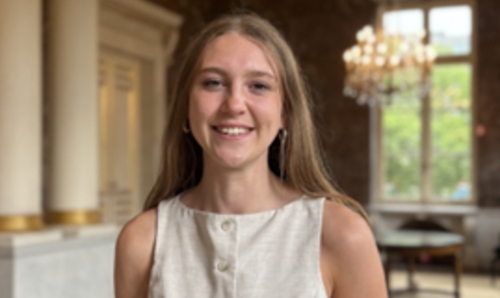
Chloe is a BA Comparative Religion and Social Anthropology Graduate who now works as a Junior Policy Officer at Re-Imagine Europa.
What does your job involve?
I analyse policy debates and developments at the European around the topic of AI, and its intersection with democracy. I also work on organising high-level events and liaising with members of the European institutions, including the European Parliament and the European Commission.
Why did you originally choose to study your course at The University of Manchester?
During my A-Levels I really enjoyed both Philosophy and Psychology, and I felt like the BA in Comparative Religion and Social Anthropology would allow me to combine these interests and learn even more about other societies, cultures and people around the world, through the lens of spirituality and belief.
How did your degree help prepare you for your current role?
Being heavily essay-based, the degree really helped me hone my writing and critical analysis skills. I learnt not only to read and annotate a lot of material in short periods of time, but also to approach my analyses through different perspectives and critical lenses.
It was also my first opportunity learning from and alongside people from such a wide variety of cultural and religious backgrounds, which has been an invaluable experience as I have moved out of the UK and learnt to adapt myself to a new country and culture, where people from all around Europe and the world are working together.
What has your career path looked like since graduation?
After graduating I immediately took a leap of faith and moved to Belgium, where I didn't know anyone or if I was going to be successful in finding a job, but this for me is what was both so unexpected and what I am so proud of now, as it has opened so many opportunities for me that I didn't think possible before.
I have had the chance to speak as a moderator at policy events, to attend debates at the European Parliament, and to organise and travel to events across Europe. This was not something I expected to achieve so soon after graduating.
Regarding personal projects, something I really enjoyed in Manchester alongside my degree was volunteering teaching English. This is something I have also continued to study in my free time and is something I hope to integrate into my career in the future.
Are there any moments from your degree that stand out as being really influential?
A module that I really enjoyed was learning about the Anthropology of Humanitarianism during my third year, and the group project that we were assigned where my group chose to write about the varying perceptions of displaced people living in Europe during the course of the 2015 'European Refugee Crisis’. This module and project gave me my first insight into humanitarianism as a subject of study, and has really influenced my desire to work in the field, supporting refugees from different communities.
This was alongside my volunteering experience teaching English to children seeking asylum in Greater Manchester, which together really inspired me to continue working in this field. Although my job currently is not in this area, I hope that by gaining policy experience that in the future I will be able to work directly on improving and humanising migration policy in Europe and the UK, to better work for the people it impacts the most.
What are the next steps for your career? What do you hope to accomplish in the future?
I would love to move into the field of Migration and Asylum Policy, preferably working more on the ground with refugees and people seeking asylum, either through a policy role or perhaps teaching English as a foreign language. I want to continue to travel and expand my horizons and knowledge of other cultures and societies, as this is what really inspired me to study my degree in the first place.
Do you have any advice for current/aspiring students?
Definitely take advantage of opportunities that arise outside of just your degree. Whilst I loved my course, some of the most valuable experiences I had at University were through volunteering and extra curricular activities, and through jumping into roles that I maybe didn't feel fully qualified or prepared for at the time, but that in the end taught me the most about working with other people and leading projects.
Regarding the degree, make the most this chance to learn alongside so many different people. This is one of the few chances you will get to study with people from all around the world - get to know them!