

New Muralism: Urban Futures Through the Arts in Italy
Research summary
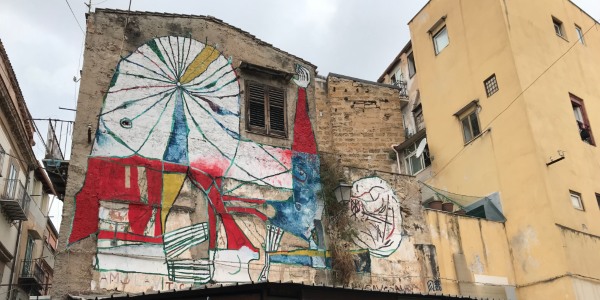
- New muralism is the site-specific production of public artworks by artists in dialogue with local communities, polities and histories.
- The project team have examined a wide breadth of new muralism case studies, spanning nine Italian cities.
- The project integrates sociological, historical, artistic and digital methods to consider the new muralism movement holistically.
The project
In 1920s Americas, and in 1930s Europe, murals have been used by communities and governments to shape urban public spaces.
Yet, scholarship on ‘old’ muralism has focused mostly on its relationship with various political regimes. However, in recent years, there has been a shift.
Over the past two decades, new muralism artists have embedded their work in the fabric of city centres and suburbs worldwide, but the focus is no longer solely on political regimes.
Instead, artists have started to produce murals which visualise social and cultural tensions generated by the arrival of new communities, ongoing political instability, and widespread structural economic change.
This project moves beyond a purely aesthetic or social focus on new muralism, instead mapping and evaluating it as an historically situated, multifaceted artistic phenomenon.
Aims
The intention is to complete the following five objectives:
- To map new muralism projects meant for urban regeneration in Italy from the 1990s to the present.
- To evaluate local communities' responses to new muralism.
- To scrutinise the work of curators, artists, cultural organisers and public institutions in the context of governmental agendas for economically sustainable urban futures.
- To make new data available on the institutional process and economic factors defining new muralism.
- To pioneer a new field of enquiry - the ecosystem of aesthetics (Ecoaetics)
Impact
Studies of new muralism have also elided broad questions about the interconnections between the political economy of new muralism, its relationship with public administrations, and its geopolitical histories.
The project will break new ground, empirically, by gathering an unprecedented wealth of data (urban planning documents, calls for funding, interviews with artists, curators and local administrators, questionnaires with local residents, transcripts of community meetings and focused groups, and images/videos of murals).
This breadth reflects the kinds of materials used by local authorities to inform project funding decisions and identify patterns of inequality to design ad hoc strategies.
Theoretically, by pioneering a multimodal methodological and conceptual framework (‘Ecoaetics’), the project will shift the scholarly paradigm past the study of the relationship between murals and the political and ideological agendas of the regimes that supported them.
Instead, it will evaluate the interconnections between the political economy of new muralism, its relationship with public administrations and its geopolitical histories.
The project’s originality also lies in the suite of outputs addressing different audiences beyond those reached by traditional monographs. These include an online exhibition and commissioned murals.