
Skip to navigation | Skip to main content | Skip to footer
The University of Manchester home
Faculty of Humanities
  • Faculty of Humanities
  • Research
  • Projects
    • Co-producing inclusive housing and care solutions with older LGBTQ people
    • Energy, data and social change in net-zero Britain
    • Everyday therapeutic consumption
    • Governance, Human Development, and Environment in Zimbabwe
    • Laboratories of Humanitarianism: Aid, Intervention, and the End of the Soviet Union
    • New Muralism: Urban Futures Through the Arts in Italy
    • The lexical semantics of lexical categories
  • Home
  • Study

    Undergraduate

    • Courses
    • Scholarships and funding
    • Request a brochure

    Taught master's

    • Courses
    • Scholarships and funding
    • Request a brochure

    Postgraduate research

    • Programmes
    • How to apply
    • Funding
    • Find a supervisor
    • Supervisor-led projects
    • Our research community
  • Research

    Centres and Institutes

    Funding and fellowships

    Impact

    Projects

    Publications

  • Connect

    Business engagement

    • Research services
    • Knowledge exchange
    • Consultancy
    • Commercialisation
    • Professional development
    • Case studies
    • Contact us

    Contact us

    Events

    Schools and colleges

    Social responsibility

  • About

    News

    Our Schools

    Our subject areas

    People

  • Faculty of Humanities
  • Research
  • Projects
  • Laboratories of Humanitarianism: Aid, Intervention, and the End of the Soviet Union
  • Faculty of Humanities
  • Research
  • Projects
    • Co-producing inclusive housing and care solutions with older LGBTQ people
    • Energy, data and social change in net-zero Britain
    • Everyday therapeutic consumption
    • Governance, Human Development, and Environment in Zimbabwe
    • Laboratories of Humanitarianism: Aid, Intervention, and the End of the Soviet Union
    • New Muralism: Urban Futures Through the Arts in Italy
    • The lexical semantics of lexical categories
Back to projects homepage
Distribution of humanitarian aid in Nazran in the Republic of Ingushetia, Russian Federation, 1993.

Laboratories of Humanitarianism: Aid, Intervention, and the End of the Soviet Union, 1985–2000

Research summary

Laboratories of Humanitarianism (LabHum) explores the transformative impact of humanitarian crisis and intervention on the USSR’s disintegration and the reconfiguration of the post-Soviet space.

The project team examine humanitarianism at multiple scales using case studies from across the vast territory of the Soviet Union, paying attention to  linguistic, cultural, and environmental diversity.

In focusing on the USSR, the project places an underexplored region at the centre of the modern history of humanitarianism.
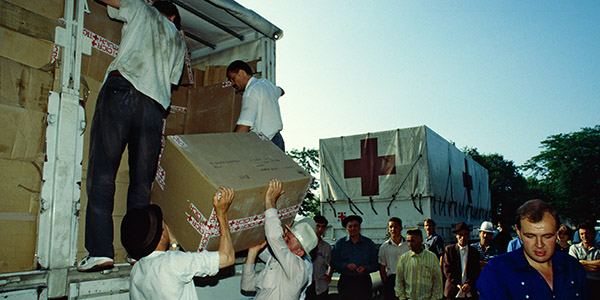
The International Committee of the Red Cross aid in Molgabek, Republic of Ingushetia, 1993.

Project overview

In the late 1980s, the USSR experienced a sharp status inversion from a superpower and major donor of global humanitarian aid to one of its primary recipients.

As radioactive fallout from Chernobyl contaminated the land and skies of the country’s western borderlands and a deadly earthquake unfolded in Armenia, millions of the country’s citizens grappled with the wide-ranging consequences of disaster.

Under the conditions of Mikhail Gorbachev’s reforms, information on humanitarian crisis reached enormous audiences both at home and abroad, Soviet citizens rapidly mobilised their own networks of relief, and international NGOs entered the USSR for the first time since the advent of Soviet power.

These moments of crisis and their aftermaths turned the country into a laboratory of humanitarian action, wherein new forms of intervention were implemented in response to displacement, disaster, and the collapse of welfare states, and humanitarianism became intertwined with new forms of political and economic governance.

LabHum investigates these processes using case studies from across the former Soviet Union.

LabHum is funded by a European Research Council Starting Grant.

People

  • Dr Siobhán Hearne
    The University of Manchester
    View Siobhán's research profile

Publications and further information

  • Siobhán Hearne, ‘AIDS and the End of the Soviet Union’, Past & Present, 267:1 (2025): 276-309.
  • Siobhán Hearne, ‘Transnational HIV-AIDS Action and Citizen Diplomacy in the Late Soviet Union, 1988–1991’, Journal of the History of Sexuality, 34:2 (2025): 242-264.

Contact us

  • +44 (0)161 306 6000
  • Contact details

Find us

The University of Manchester
Oxford Rd
Manchester
M13 9PL
UK

Connect with us

  • Facebook page for Faculty of Humanities
  • YouTube page for Faculty of Humanities
  • Instagram page for Faculty of Humanities
  • WordPress page for Faculty of Humanities

  • Disclaimer
  • Data Protection
  • Copyright notice
  • Accessibility
  • Freedom of information
  • Charitable status
  • Royal Charter Number: RC000797