

Integrating Creative Health in Greater Manchester
Research summary
- Exploring creative health in Greater Manchester by using the GM Creative Health Place Partnership Programme as a case study.
- Investigating how creative health can be embedded within health systems and regional government to improve population health and reduce health inequalities.
- Building a GM-wide interdisciplinary, cross-sector creative health network, bringing together policy, practice, and research.
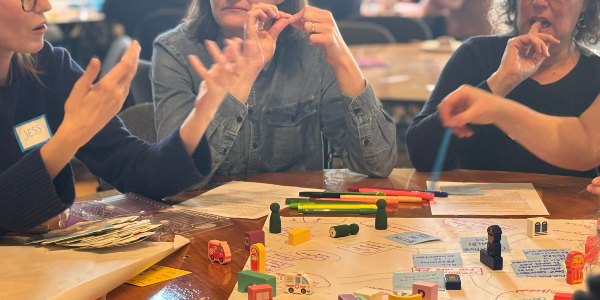
Project overview
Creative health refers to the connection between creative and cultural activity and longer, healthier, happier lives. Increasingly, policymakers are recognising the power of creativity to improve health and address inequalities. Greater Manchester (GM) has been a pioneer, publishing the GM Creative Health Strategy in 2022.
Building on the previous research project, Organisations of Hope, the University of Manchester is working with partners across GM to explore the region’s creative health ecosystem and how creative health can be embedded as an integral part of the health and social care system, with learning that will be applicable more widely.
The findings
The GM Creative Health Place Partnership brings together NHS GM, GMCA, ten GM local authorities and partners from the cultural, VCFSE, health, social care and higher education sectors.
Alongside the development of creative health capacity and infrastructure, it delivers six work strands that focus on identified challenges:
- early years and school readiness;
- early years and speech and language;
- neurodivergent young adults getting into work;
- global majority communities and mental health;
- adults living with long-term lung conditions;
- older people with caring responsibilities.
A Knowledge Mobilisation Research Associate (Hannah Waterson), funded by the GM Civic University Accord and based at the University of Manchester, works as an embedded researcher to evaluate the programme.
The evaluation takes a whole-system approach to understand how and where creative health operates within the GM system. It draws on qualitative and mapping approaches to identify the key levers that enable sustainable integration of creative health, with findings that will be valuable for systems beyond GM.
Further related research projects include:
- AHRC Creative Communities funded Creative Health Policy Co-Lab Work with the Mayoral and Strategic Authorities Creative Health Network to explore creative health in devolved policy contexts across England.
- Faculty of Humanities Strategic Civic Engagement Fund award to co-design creative health neighbourhoods with Stockport residents.
- An MOU with Tokyo University of the Arts, Arts-Based Communication Platform for Co-creation to Build a Convivial Society and National Centre for Art Research in Japan to strengthen international research collaborations around creative health
Impact
With national and regional policy focusing on a shift towards preventative and neighbourhood approaches to health and wellbeing, this research is timely in exploring the role of creative health in this space and how systems can utilise creative and cultural assets to improve health and wellbeing.
In addition to informing the next stages of creative health strategy in Greater Manchester, the research and associated projects will propose frameworks to better understand how creative health integrates into systems across England and internationally.
Creative health is an exciting and rapidly expanding research area that is highly interdisciplinary, bringing together different forms of research, policy, and practice to evidence the many ways creativity and culture influence our health and wellbeing. This workstream provides a forum for learning and exchange, with opportunities for interdisciplinary and cross-sectoral collaboration across Greater Manchester.
Meet the team
Key people
- Dr Simon Parry, University of Manchester
- Dr Hannah Waterson, University of Manchester
Key partners
- Greater Manchester Combined Authority (GMCA)